What Makes a PCB "IoT-Ready"?
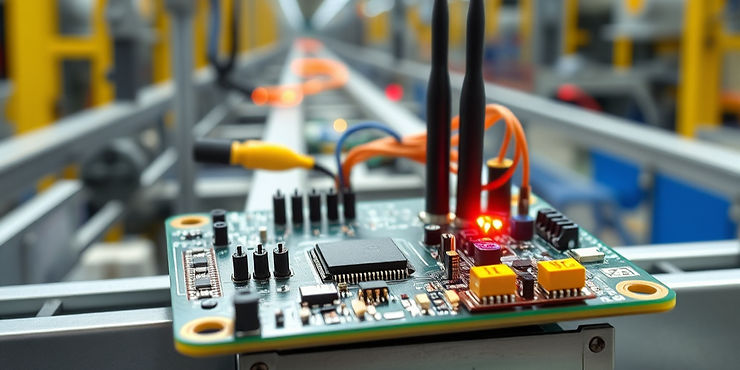
An industrial PCB must go far beyond simply powering a device. It needs to be designed from the ground up to enable connectivity, perform local processing, and, most importantly, survive a rugged industrial environment.
Here are the key features that define an IoT-ready PCB:
-
Integrated Communication Modules: Connectivity is non-negotiable.
-
Wireless Options: For flexibility and remote monitoring, this includes Wi-Fi, Bluetooth Low Energy (BLE), Zigbee, or long-range LPWAN protocols like LoRa and NB-IoT (or even 5G).
-
Wired Options: For mission-critical, high-reliability links, you need robust industrial standards like Ethernet, RS-485, or CAN bus.
-
-
Sensor Integration: The "Things" in the IIoT are often the sensors. The PCB must be able to host or connect external sensors for temperature, vibration, pressure, and humidity, alongside the necessary circuitry for real-time data acquisition.
-
Edge Processing: To avoid overwhelming cloud servers and to handle latency-sensitive tasks, the PCB needs local intelligence. Microcontrollers (MCUs) or System-on-Modules (SoMs) filter and preprocess data right at the source, reducing bandwidth costs and response times.
-
Rugged Design: An industrial environment is tough. These PCBs require:
-
Conformal coating and EMI shielding to protect components.
-
High-Tg (glass transition temperature) laminates for structural integrity.
-
An extended temperature tolerance (often −40 °C to +125 °C) to withstand extreme conditions near production lines.
-
The Industrial Impact: Why These Boards Are Critical
Integrating this technology directly onto the PCB provides massive value across industrial operations:
-
Enabling Predictive Maintenance: By continuously monitoring subtle anomalies like vibration patterns or thermal loads, IoT-enabled equipment can flag a component failure before it happens. This single capability dramatically reduces unplanned downtime—a major cost driver in any factory.
-
Driving Energy Efficiency: Real-time data helps optimize power use. For example, a factory's HVAC system can dynamically adjust based on machine heat output and occupancy, slashing energy waste.
-
Optimizing Logistics and Supply Chain: IoT-ready PCBs embedded in assets, smart packaging, or warehouse systems provide live asset tracking, ensuring materials flow smoothly and reducing bottlenecks in the production line.
-
Ensuring Safety and Compliance: Embedded sensors monitor critical parameters, from chemical concentrations to air quality, helping companies comply with strict safety standards like OSHA, ISO, and IEC.
Overcoming the Design Hurdles
Designing a robust, high-performance industrial IoT PCB is complex. It requires specialized engineering to tackle common challenges:
-
Electromagnetic Interference (EMI): Combining multiple radio systems and high-speed processors creates a lot of noise. This demands careful grounding, layout design, and shielding to prevent components from interfering with each other.
-
Thermal Management: Industrial enclosures can be compact, leading to heat buildup. Engineers must use techniques like thermal vias and heavy copper pours to dissipate heat and maintain reliability.
-
Security by Design: Connectivity opens the door to cyber threats. Hardware-level cryptography and secure elements must be embedded directly on the PCB to protect sensitive industrial data.
-
Testing & Certification: IoT PCBs often require exhaustive compliance testing (like FCC, CE, or UL) for wireless and safety standards, adding layers of complexity to the manufacturing process.
Case Example: The Edge Gateway
Consider a factory floor edge gateway built around an IoT-ready PCB. This board doesn't just manage one type of data; it acts as a central hub:
-
It integrates Ethernet for robust communication with local programmable logic controllers (PLCs).
-
It utilizes LoRa modules to talk wirelessly to a multitude of remote, low-power sensors scattered across the facility.
-
An onboard microcontroller filters and compresses the raw data, only sending actionable, secure reports to the cloud, saving significant bandwidth costs.
With its rugged design—including a conformal coating and extended-temperature components—this board reliably transforms legacy machines into smart, connected assets, resulting in reduced downtime and dramatically improved efficiency.
If you're an OEM designing the next generation of industrial equipment, you need a manufacturing partner who understands these complexities.
Sanbor Manufacturing specializes in building custom, rugged PCB assemblies for industrial OEMs. With facilities across Asia and Europe, we provide:
-
Cost-efficient manufacturing in low-cost countries while maintaining global quality standards.
-
Experience in Rugged Industrial Design: Expertise in conformal coating, EMI shielding, and rigorous functional testing required for industrial-grade PCBs.
-
Global Scalability: The ability to scale from initial prototypes to high-volume production, helping you bring your IoT-enabled products to market quickly and competitively.
For more information, contact us at 610-530-8500 or email sales@sanbormfg.com.