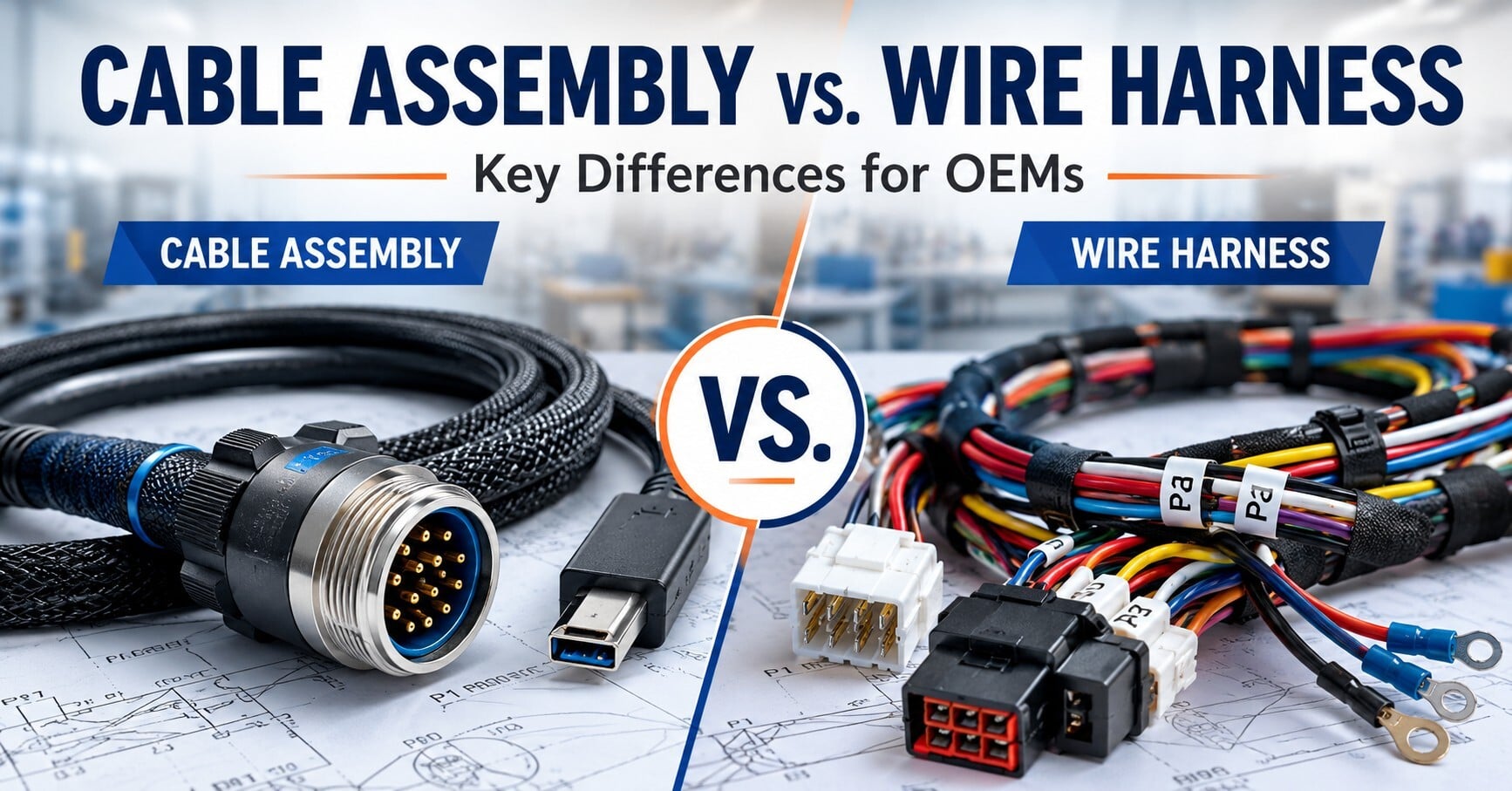
Custom cable assemblies may look straightforward on a drawing, but small design or sourcing decisions can have a major impact on performance, cost, manufacturability, and long-term reliability.
For OEMs, a cable assembly is more than a set of wires connected to terminals. It is a functional part of the product architecture. It must fit the application, withstand the operating environment, support electrical performance, and be built consistently at production scale.
Sanbor Manufacturing identifies cable assembly as one of its core services, supporting OEMs across industries with cable assembly, wire harness assembly, PCBA manufacturing, and broader contract manufacturing capabilities.
What You'll Learn
Custom cable assembly manufacturing requires more than selecting wires and connectors. OEMs should evaluate electrical requirements, operating environment, connector selection, shielding, jacket materials, strain relief, labeling, testing, documentation, and production scalability. A qualified cable assembly manufacturer can help identify design and sourcing issues before they create cost, quality, or lead-time problems.
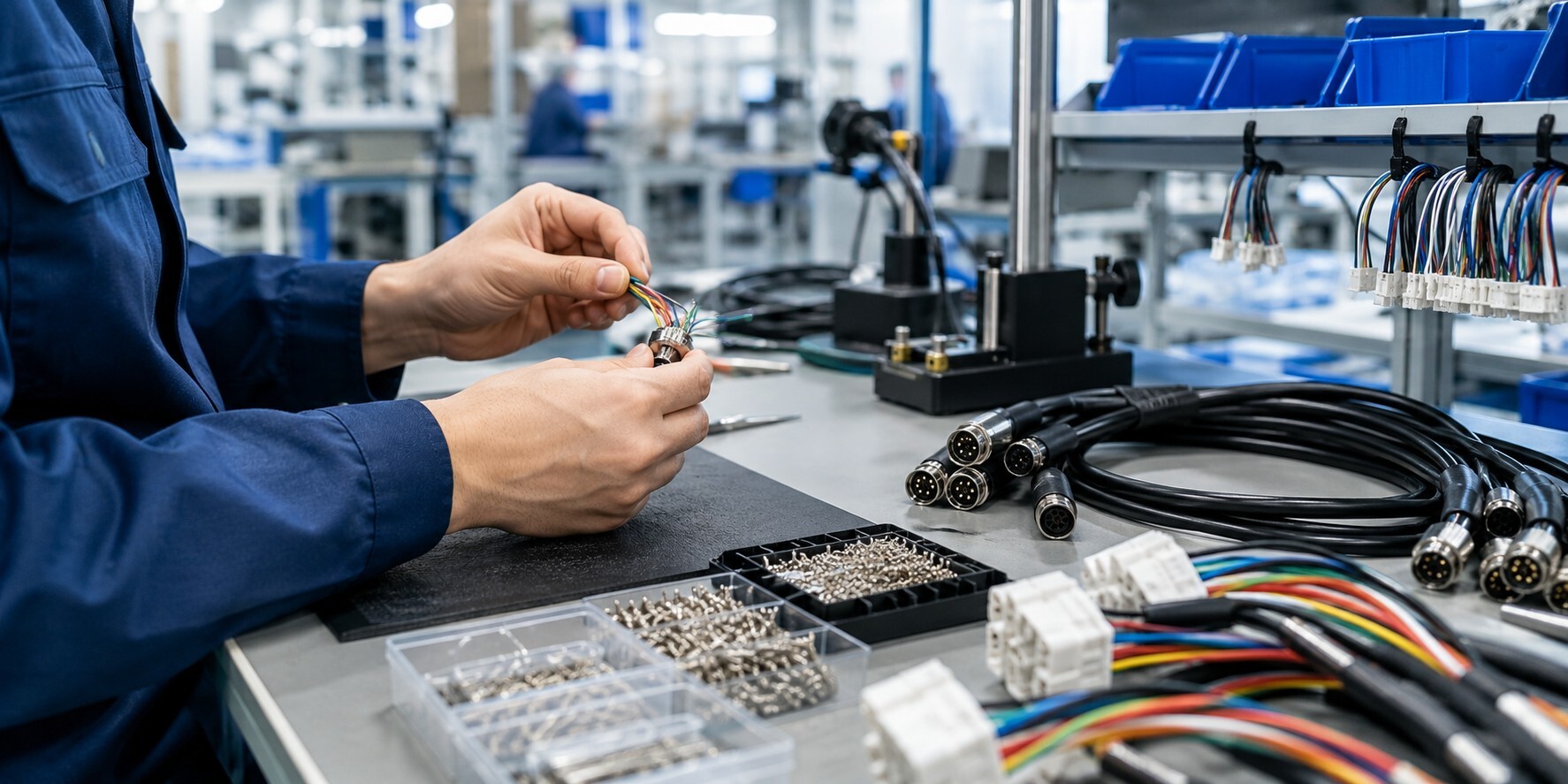
What is custom cable assembly manufacturing?
Custom cable assembly manufacturing is the process of building cable assemblies to match the OEM’s specific electrical, mechanical, environmental, and application requirements.
A custom cable assembly may include:
- Wires or multi-conductor cables
- Connectors and terminals
- Shielding
- Sleeving
- Jacketing
- Labels and serialization
- Overmolding
- Strain relief
- Ferrites or other components
- Test requirements
- Packaging specifications
Unlike off-the-shelf cables, custom cable assemblies are built around the final product’s design, installation process, operating conditions, and performance requirements.
Why cable assembly design matters
Cable assembly issues can create downstream problems that are expensive to correct. A connector that is difficult to source can delay production. A cable jacket that is not suited for the environment can fail prematurely. Poor strain relief can cause intermittent failures. Inadequate shielding can create signal issues. A design that is difficult to assemble can increase labor cost and quality risk.
These issues become more costly as production scales. Sanbor’s article on scaling cable assemblies from prototype to volume production explains why documentation, consistency, and repeatable workflows are critical as OEM programs move beyond early builds.
That is why OEMs should bring manufacturing input into the process before the design is fully locked.
Key design considerations for custom cable assemblies
1. Electrical requirements
The cable assembly must support the required voltage, current, signal type, data speed, and electrical performance. Wire gauge, conductor material, shielding, insulation, and connector selection all play a role.
For higher-performance applications, the design may also need to account for signal integrity, EMI protection, grounding, impedance, or separation of power and signal conductors.
2. Operating environment
A cable assembly used inside a protected enclosure has different requirements than one used in an industrial, automotive, aerospace, or outdoor environment.
OEMs should define exposure to:
- Heat or cold
- Moisture
- Chemicals
- Abrasion
- Flexing or movement
- Vibration
- UV exposure
- EMI or electrical noise
- Cleaning agents
- Installation stress
The operating environment helps determine jacket material, shielding, sealing, overmolding, and strain relief requirements.
3. Connector and terminal selection
Connectors are often one of the most important cost, quality, and lead-time drivers in cable assembly manufacturing.
A qualified manufacturing partner can help evaluate whether the selected connectors are readily available, appropriate for the application, easy to assemble, compatible with the mating component, and suitable for the required production volume.
Poor connector selection can lead to fit issues, long lead times, high scrap, field failures, or costly redesigns.
4. Strain relief and bend radius
Cable assemblies often fail where movement or stress is concentrated. Strain relief helps protect the connection point between the cable and connector. Bend radius requirements help prevent internal conductor damage, jacket cracking, or signal degradation.
This is especially important in compact products or applications with tight routing paths. For a deeper look at these design factors, see Sanbor’s article on routing, bend radius, and strain relief strategies.
5. Shielding and EMI protection
Shielding may be required when the cable assembly carries sensitive signals or operates near motors, power electronics, RF sources, or other sources of electrical noise.
Shielding decisions should be based on the actual application, not simply added as a default. Over-specifying shielding can increase cost, while under-specifying shielding can create performance problems.
6. Labeling, serialization, and documentation
As production scales, clear identification becomes more important. Labels, part numbers, revision levels, serialization, and packaging instructions help prevent assembly errors, improve traceability, and simplify service.
For regulated or quality-sensitive industries, documentation and traceability may be essential to customer acceptance.
Cable and wire harness manufacturing processes may include cutting, stripping, crimping, connector application, shielding, labeling, serialization, and documented process controls aligned with IPC/WHMA-A-620 standards.
What should OEMs include in a cable assembly RFQ?
A strong RFQ helps the manufacturing partner provide a more accurate quote and identify risks earlier.
OEMs should include:
- Drawings or specifications
- BOM
- Wire and cable requirements
- Connector part numbers
- Target annual volume
- Forecast or demand expectations
- Test requirements
- Labeling requirements
- Packaging requirements
- Compliance or certification needs
- Required documentation
- Production location preferences
- Target cost or cost reduction goals
- Current supplier issues, if applicable
The more complete the RFQ, the easier it is to evaluate manufacturability, material availability, test requirements, and production readiness.
Send Sanbor your cable assembly drawings, BOM, or specifications for review.
Why supplier capability matters
A custom cable assembly manufacturer should be able to support more than the physical build. OEMs should look for a partner that can support design review, sourcing, documentation, testing, quality control, and production scalability.
Sanbor’s cable and wire harness capabilities include processes such as cutting, stripping, crimping, connector application, shielding, labeling, serialization, and custom harness board routing, with documented processes aligned to IPC/WHMA-A-620 standards.
From cable assembly to broader contract manufacturing
Many OEMs source cable assemblies as part of a larger production program involving wire harnesses, PCBAs, plastic components, or final assemblies. When those processes are managed separately, handoffs can introduce delays, quality issues, and communication gaps.
When cable assemblies, wire harnesses, and PCBAs are managed by separate suppliers, handoffs can introduce delays, quality issues, and communication gaps. That is why many OEMs evaluate the benefits of bundling PCBA, cable assembly, and wire harness manufacturing with one partner.
Final takeaway
Custom cable assembly manufacturing is not just a purchasing decision. It is an engineering, quality, sourcing, and production decision.
OEMs that involve the right manufacturing partner early can reduce design risk, improve manufacturability, control cost, and build a more reliable path from prototype to production.
For OEMs evaluating a new cable assembly supplier, Sanbor Manufacturing can help review design requirements, sourcing needs, testing expectations, and production goals.
If your team is evaluating a new cable assembly supplier or preparing an RFQ, contact Sanbor Manufacturing to discuss your drawings, specifications, production requirements, and sourcing goals.
FAQ: Custom Cable Assembly Manufacturing
What is custom cable assembly manufacturing?
Custom cable assembly manufacturing is the process of building cable assemblies to match a product’s specific electrical, mechanical, environmental, and performance requirements. Instead of using an off-the-shelf cable, OEMs work with a manufacturing partner to define the wire or cable type, connectors, shielding, jacketing, strain relief, labeling, testing, and documentation needed for the final application.
Custom cable assemblies are commonly used when a product requires specific connection points, durability, signal performance, routing, environmental protection, or production repeatability.
What should be included in a custom cable assembly RFQ?
A custom cable assembly RFQ should include the information a manufacturer needs to evaluate material requirements, production complexity, testing needs, and cost. At minimum, OEMs should provide drawings, specifications, a bill of materials, connector part numbers, wire or cable requirements, target annual volume, forecast expectations, test requirements, labeling requirements, packaging instructions, compliance needs, and any environmental or application-specific requirements.
If the assembly is currently in production, it is also helpful to include known supplier issues, quality concerns, cost targets, or desired improvements. A more complete RFQ helps the manufacturing partner provide accurate pricing and identify manufacturability risks earlier.
How do connectors affect cable assembly performance?
Connectors play a major role in cable assembly performance because they influence electrical continuity, signal integrity, durability, installation, serviceability, and long-term reliability. The wrong connector can create fit issues, intermittent connections, lead-time delays, higher costs, or field failures.
When selecting connectors, OEMs should consider the mating interface, current and voltage requirements, pin count, locking features, environmental exposure, vibration, insertion cycles, size constraints, and availability. Connector selection should also account for production volume and sourcing risk, since long-lead or single-source connectors can affect cost and delivery timelines.
Why is strain relief important in cable assemblies?
Strain relief helps protect the point where a cable enters a connector, housing, or termination area. Without proper strain relief, pulling, bending, twisting, or repeated movement can stress the conductors, damage insulation, loosen terminations, or cause intermittent electrical failures.
Strain relief is especially important in applications where the cable will be handled frequently, routed through tight spaces, exposed to vibration, connected and disconnected often, or used in demanding operating environments. Depending on the design, strain relief may be achieved through molded features, boots, clamps, grommets, cable ties, sleeving, or connector-integrated protection.
What testing should be performed on custom cable assemblies?
Testing requirements depend on the application, but custom cable assemblies are commonly tested for continuity, correct wiring, shorts, opens, insulation resistance, and electrical performance. Some applications may also require hipot testing, pull testing, functional testing, visual inspection, dimensional checks, or connector fit verification.
For more demanding environments, OEMs may require additional testing related to flex life, vibration, shielding effectiveness, environmental exposure, or application-specific performance. Testing should be clearly defined before production so the manufacturer can build the right inspection and validation steps into the process.
When should an OEM use a custom cable assembly instead of an off-the-shelf cable?
An OEM should consider a custom cable assembly when an off-the-shelf cable does not meet the product’s performance, routing, durability, connector, labeling, or environmental requirements. Custom assemblies are often needed when the product has unique connection points, defined cable lengths, specific shielding needs, tight space constraints, or quality and documentation requirements.
A custom cable assembly can also improve installation efficiency and reduce variability during production because it is designed around the final product rather than adapted after the fact.
What industries use custom cable assemblies?
Custom cable assemblies are used across many OEM industries, including industrial equipment, medical devices, aerospace, automotive, communications, consumer electronics, robotics, control systems, power equipment, and transportation. Any product that requires reliable electrical, signal, or data connections may require a custom cable assembly.
The specific design requirements vary by industry. For example, industrial applications may emphasize durability and resistance to vibration, while communications applications may place more emphasis on signal integrity and shielding.
How can design for manufacturability improve a cable assembly?
Design for manufacturability can improve a cable assembly by identifying design, sourcing, and production issues before they create cost or quality problems. A manufacturability review may uncover opportunities to simplify connector selection, standardize materials, improve bend radius, add strain relief, reduce assembly labor, improve testability, or avoid long-lead components.
For OEMs, early manufacturability input can help reduce redesigns, improve production consistency, shorten lead times, and support a smoother transition from prototype to volume production.