Key Article Points
How does contract manufacturing reduce manufacturing costs?
Contract manufacturing reduces costs through economies of scale, optimized sourcing, automated production processes, and shared manufacturing infrastructure.What industries benefit most from contract manufacturing?
Industries such as medical devices, automotive, aerospace, communications, and industrial electronics frequently use contract manufacturing to improve efficiency and reduce production costs.What manufacturing processes can be outsourced to reduce cost?
OEMs commonly outsource cable assemblies, wire harnesses, PCB assemblies, box builds, and electromechanical assemblies.
How Contract Manufacturing Helps OEMs Reduce Manufacturing Costs
For many OEMs, reducing manufacturing cost is a constant priority. Rising labor expenses, supply chain disruptions, regulatory requirements, and increasing product complexity all place pressure on margins. As a result, companies across industries are increasingly turning to contract manufacturing partners to lower total production costs while improving operational efficiency.
OEMs reduce manufacturing costs by outsourcing production to specialized contract manufacturers that provide optimized supply chains, automated production systems, and shared manufacturing infrastructure. Contract manufacturing reduces labor costs, improves sourcing efficiency, and lowers total cost of ownership for cable assemblies, wire harnesses, PCB assemblies, and electromechanical products.
While outsourcing is often associated with moving production to lower-cost regions, the real value of contract manufacturing goes much deeper. When implemented strategically, outsourcing cable assemblies, wire harnesses, PCB assemblies (PCBAs), and box build assemblies can reduce total cost of ownership, improve quality performance, and allow OEMs to scale production more efficiently.
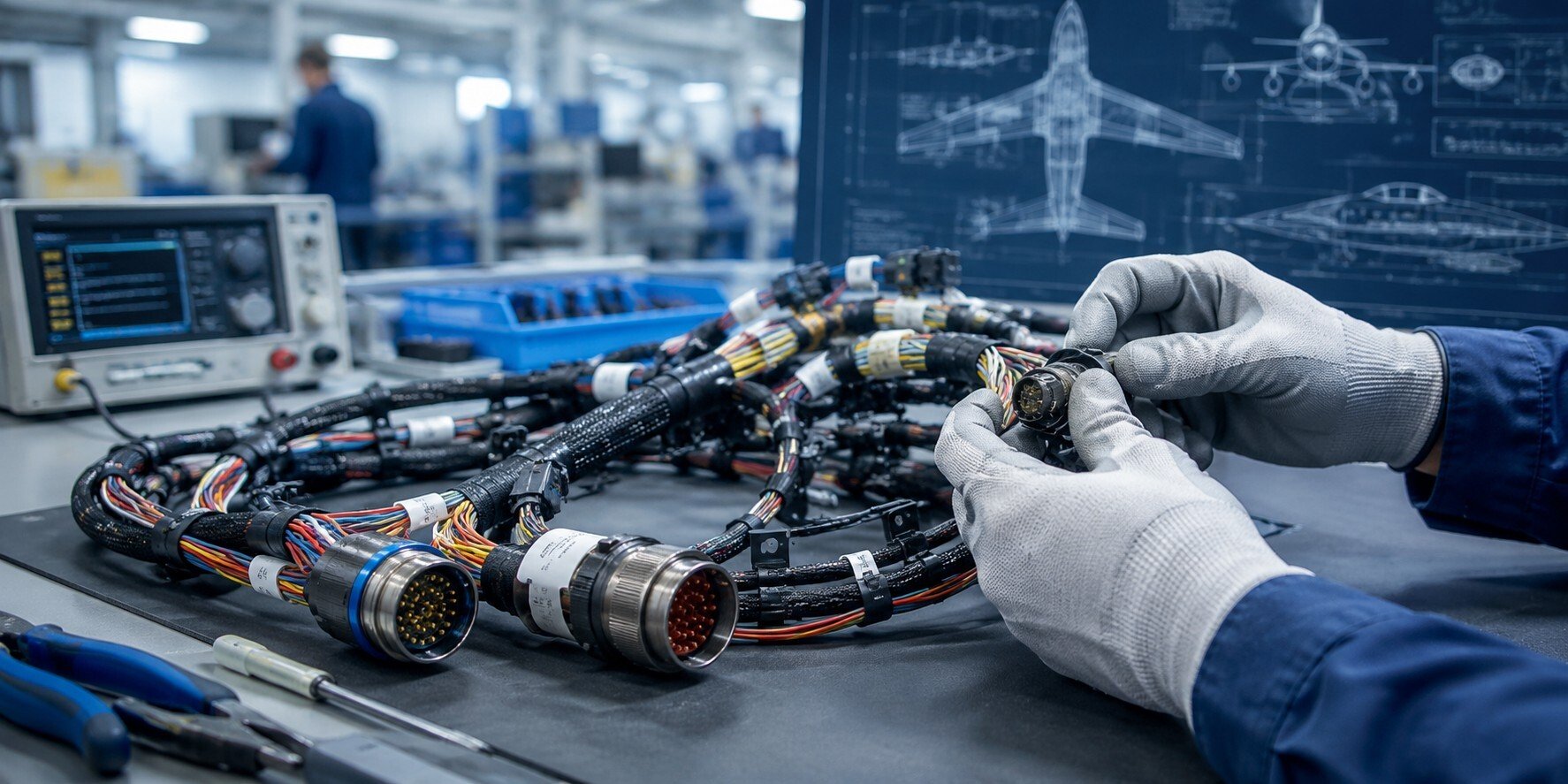
Specialized contract manufacturers bring focused expertise, dedicated equipment, and trained production teams that many OEMs cannot easily replicate internally. Investments in automated wire processing, crimping systems, selective soldering, conformal coating, and functional test platforms are shared across multiple programs and customers. This shared infrastructure spreads capital costs across production volumes, reducing the per-unit manufacturing cost for each OEM.
Additionally, manufacturers operating under robust quality management systems such as ISO 9001, ISO 13485, IATF 16949, and AS9100, establish standardized processes that reduce scrap, minimize rework, and support repeatable production. Stable manufacturing systems not only lower operational costs but also simplify scaling production as product demand grows.
For highly regulated sectors like medical devices, contract manufacturing partners can manage complex requirements such as traceability, serialization, validation, and controlled production environments. Meanwhile, industries such as automotive, aerospace, and communications benefit from improved supply chain coordination and reduced engineering overhead.
Ultimately, cost reduction is not just about lowering the price of individual components. It includes lowering operational complexity, improving manufacturing efficiency, and freeing internal engineering teams to focus on product innovation.
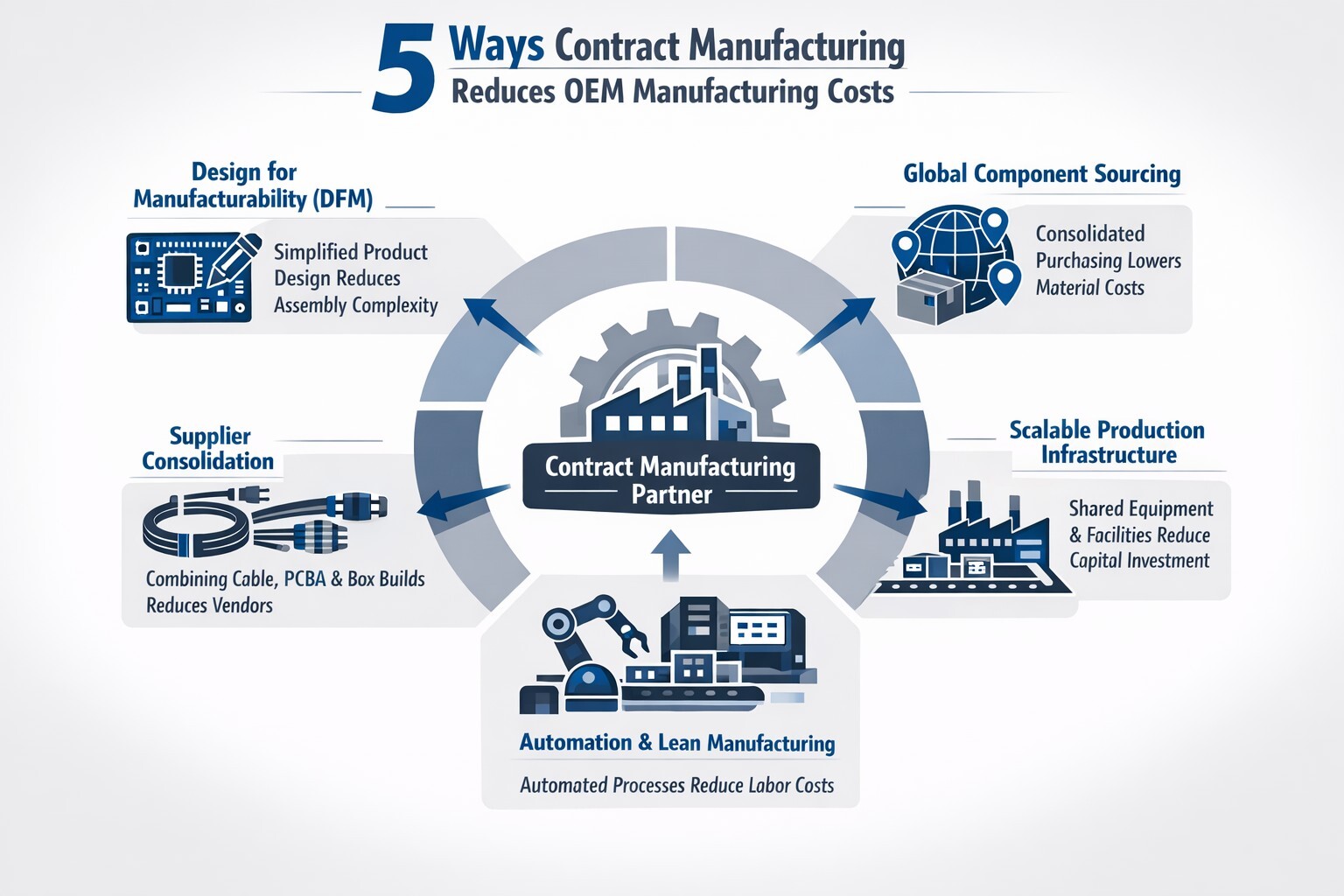
The graphic below highlights five of the most impactful ways contract manufacturing helps OEMs reduce total production costs.
Design and Sourcing Strategies That Reduce Manufacturing Costs
Once an OEM decides to outsource manufacturing, the next step is ensuring the product design and sourcing strategy enable cost-efficient production. The most effective cost reduction strategies often begin long before the first production build.
Design for Manufacturability (DFM)
One of the most powerful ways to reduce manufacturing cost is through Design for Manufacturability (DFM). During early product development, contract manufacturers can identify design decisions that unnecessarily increase complexity or production time.
Common cost drivers include:
- Overly complex cable routing
- Custom connector configurations where standard parts would suffice
- Tight tolerances that increase scrap rates
- Excessive part count within assemblies
By engaging a manufacturing partner early, OEMs can simplify product architecture while maintaining performance requirements. In highly regulated industries, DFM recommendations are reviewed alongside regulatory and biocompatibility requirements to ensure compliance remains intact.
Strategic Component Sourcing
Materials and electronic components often account for 40–60% of total manufacturing cost in electromechanical assemblies.
Contract manufacturers with established global supply chain networks can:
- Consolidate purchasing volume across multiple customers
- Negotiate more competitive component pricing
- Identify cost-effective alternate components
- Reduce supplier management overhead
These sourcing advantages frequently generate significant cost savings compared to OEMs managing fragmented supplier networks independently.
Process Optimization and Automation
Efficient production processes are another key driver of cost reduction. Contract manufacturers continuously optimize production through:
- Lean manufacturing principles
- Standardized work instructions
- Line balancing
- Automated wire processing and crimping
- Automated testing and inspection
Automation reduces labor variability while improving consistency and quality. For industries with strict reliability expectations, automated processes also strengthen traceability and process control.
When these improvements are implemented together, they create a production environment that minimizes scrap, reduces labor content, and improves throughput.
Long-Term Partnerships Unlock Sustainable Cost Savings
Achieving long-term cost reduction requires more than simply transferring production to a contract manufacturer. The most successful OEMs build collaborative partnerships that focus on continuous improvement.
Shared Performance Metrics
Effective partnerships track metrics beyond unit price, including:
- On-time delivery performance
- First-pass yield
- Defect per million (DPM)
- Warranty or field return trends
- Total landed cost
Monitoring these indicators ensures cost reductions are achieved without compromising quality or reliability.
Continuous Improvement Programs
Regular business reviews between OEM and contract manufacturer teams help identify new cost-reduction opportunities. These reviews typically include engineering, quality, supply chain, and operations stakeholders.
Continuous improvement initiatives may include:
- Automation investments
- Design simplification projects
- Process improvements
- Supply chain optimization
Some organizations implement shared savings models where cost reductions achieved through joint improvement initiatives are shared between both parties.
Supplier Consolidation
Many OEMs discover that supplier consolidation in electronics manufacturing can significantly reduce administrative overhead while improving coordination. When cable assemblies, wire harnesses, PCBAs, and box builds are managed by a single contract manufacturer, OEMs benefit from:
- Reduced supplier management overhead
- Fewer logistics handoffs
- Faster engineering feedback loops
- Improved production coordination
Supplier consolidation also enables design feedback from later-stage system testing to quickly inform upstream component improvements.
Global Manufacturing Flexibility
Many contract manufacturers operate global production facilities that allow OEMs to balance cost efficiency and supply chain resilience.
Region-to-region manufacturing strategies help companies:
- Mitigate tariffs
- Reduce shipping costs
- Manage geopolitical risk
- Maintain production continuity
This flexibility allows OEMs to optimize manufacturing cost structures while maintaining agility as market conditions change.
The Strategic Value of Contract Manufacturing
When OEMs approach contract manufacturing as a strategic partnership rather than a short-term outsourcing decision, the cost benefits become significantly more impactful.
Outsourcing cable assemblies, wire harnesses, PCB assemblies, and box builds to an experienced manufacturing partner allows OEM teams to focus on innovation, product design, and customer experience while experts manage the complexity of production, quality control, and supply chain management.
By combining design optimization, global sourcing strategies, efficient manufacturing processes, and long-term continuous improvement programs, contract manufacturing can deliver sustainable cost reductions while improving product quality and scalability.
For OEMs seeking to improve margins while maintaining reliability and regulatory compliance, contract manufacturing has become a critical component of modern product development and production strategies.
To learn how Sanbor Manufacturing helps OEMs reduce production costs through integrated contract manufacturing services, contact our team at 610-530-8500 or email sales@sanbormfg.com.